
Hiatus Hernia Surgery in London
Many people live with a hiatus hernia without needing surgery, but when it causes persistent acid reflux, difficulty swallowing, or chest pain that does not respond to medication, surgical treatment can offer lasting relief.
Mr Mohamed Aly is a specialist laparoscopic upper GI surgeon based in Central and Northwest London. He leads hiatus hernia surgery at The Hillingdon Hospitals NHS Foundation Trust and also offers treatment through Circle Healthcare and London International Patient Services. He performs almost all of these operations by keyhole (laparoscopic) surgery, meaning minimal scarring and a rapid recovery.
If you are considering hiatus hernia surgery in London, please get in touch to see what are your treatment options.
What Is a Hiatus Hernia?
The diaphragm is a sheet of muscle that separates the chest from the abdomen. There is a small opening in the diaphragm called the hiatus, through which the oesophagus passes on its way to the stomach. A hiatus hernia occurs when the stomach — or occasionally other abdominal organs — slides or pushes up through this opening into the chest.
There are two main types: a sliding hiatus hernia, which is the most common, and a para-oesophageal hernia, which is less common but more likely to require surgery.
Symptoms
Common symptoms of a hiatus hernia include:
- Persistent heartburn or acid reflux
- Regurgitation of food or liquid
- Difficulty swallowing (dysphagia)
- Chest pain or discomfort
- Feeling full quickly after eating
- Shortness of breath in larger hernias
Symptoms often worsen after meals, when lying down, or when bending forward.
When is surgery recommended?
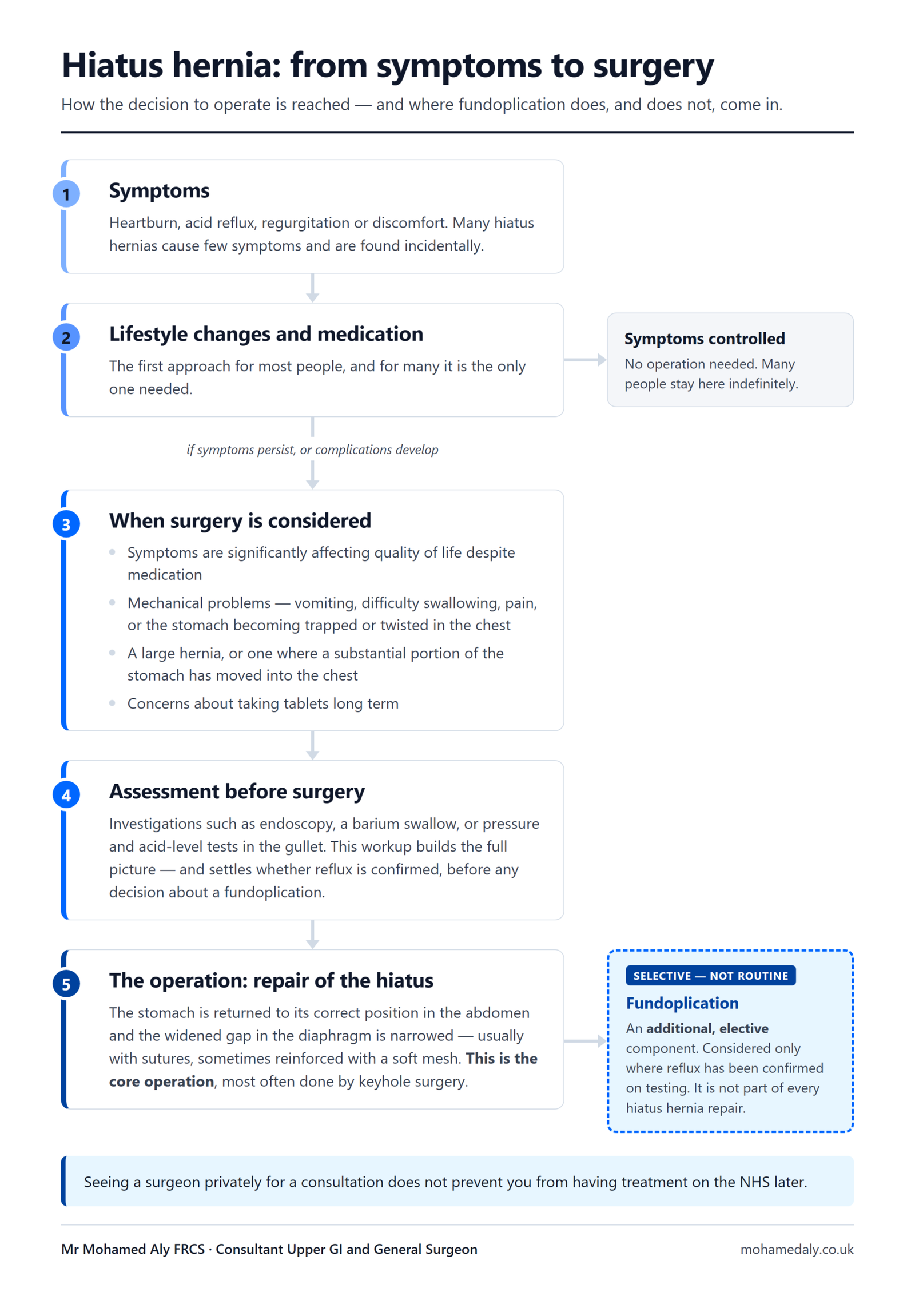
Surgery is considered when symptoms are not controlled by medication such as proton pump inhibitors (PPIs), when you wish to stop taking long-term medication, when the hernia is large or at risk of complications, or when there is a risk of the hernia becoming stuck or twisted (strangulation).
Mr Aly will assess your individual situation and discuss whether surgery is the right choice for you. Not everyone with a hiatus hernia requires an operation, and all options will be explained clearly at your consultation.
The Operation — Laparoscopic Hiatus Hernia Repair
The mainstay of hiatus hernia surgery is repair of the hiatus itself. Mr Aly returns the stomach to its correct position below the diaphragm and narrows the enlarged opening in the diaphragm using stitches, restoring the normal anatomy. In larger hernias, where a significant portion of the stomach has moved into the chest, this repair is the primary and most important component of the operation.
In patients who also suffer from acid reflux, and where this has been confirmed through appropriate investigations, an anti-reflux procedure called a fundoplication may be added. This involves wrapping the upper part of the stomach around the lower oesophagus to strengthen the valve and prevent acid from travelling upwards. However, this is an additional step performed selectively — not a routine part of every hiatus hernia repair.
The operation is performed under general anaesthetic using a laparoscopic (keyhole) approach through small incisions in the abdomen. Mr Aly performs almost all of these operations using keyhole techniques, meaning less scarring, less pain, and a faster recovery. Most patients are discharged the following day and return to normal activities within 2–4 weeks.
Recovery
Most patients experience a straightforward recovery following laparoscopic hiatus hernia repair. You can expect:
- 1 to 2 nights in hospital after the procedure
- A soft or liquid diet for the first 2 to 4 weeks while swelling settles
- A return to light activities within 1 to 2 weeks
- A return to work within 2 to 4 weeks for a desk job, or 4 to 6 weeks for manual work
- Avoiding heavy lifting for 4-6 weeks
Mr Aly provides all patients with detailed dietary advice after surgery and arranges close follow-up to monitor recovery. Any questions after your operation can be directed to our team at any time.
Can you get hiatus hernia surgery on the NHS?
Yes, hiatus hernia surgery is available on the NHS. Usually, your GP, after seeing you, sends your case to a specialist — either a gastroenterologist or an upper gastrointestinal surgeon — who will assess whether an operation is appropriate for you.
Not everyone with a hiatus hernia needs an operation, particularly if symptoms are mild or well controlled with medication. Your GP is the right starting point for finding out what is available through your local service.
Some patients private practice, either because they want a faster route to a specialist opinion or because they would prefer to discuss all available options in detail. Seeing a surgeon privately for a consultation does not prevent you from having treatment on the NHS later, and it can help you understand your choices more clearly before deciding on a path.
What is the difference between repairing the hiatus and a fundoplication?
These are two separate things, and it is important to understand the difference.
The core of the operation is the repair of the hiatus — the opening in the diaphragm through which the stomach has herniated. The surgeon returns the stomach to its correct position in the abdomen and narrows the widened gap in the diaphragm, usually with sutures and sometimes with a soft mesh to reinforce the repair. This is what every hiatus hernia operation involves.
A fundoplication is an additional procedure that the surgeon may perform at the same time as the hiatus repair, but it is not a routine part of every operation. It involves wrapping the upper part of the stomach around the lower gullet to create a valve that helps prevent stomach acid from refluxing upwards.
Not everyone who has a hiatus hernia repair needs or is suitable for a fundoplication. Whether it is appropriate for you depends on your individual test results and symptoms, and this is something your surgeon will discuss with you based on your full assessment.
Understanding this difference matters because it affects what to expect from the operation.
Frequently asked questions
Do I need a GP referral to see a surgeon about my hiatus hernia?
On the NHS, a GP referral is the standard route to seeing a specialist. If you are considering a private consultation, the process may differ — it is worth contacting a surgical practice directly to to find out how to book the appointment directly..
Will I definitely need surgery if I have a hiatus hernia?
No. Most people with a hiatus hernia are managed successfully with lifestyle changes and medication. Surgery is considered when symptoms are severe, when medication is not providing adequate control, or when the hernia is causing mechanical problems. A specialist assessment is needed to determine what is right for you.
Is keyhole surgery always possible for a hiatus hernia?
Keyhole (laparoscopic) surgery is the preferred approach for most hiatus hernia repairs and is suitable for the majority of patients. In some cases — for example, if a hernia is very large or complex, or if there has been previous abdominal surgery — open surgery may be more appropriate. Your surgeon will explain which approach is recommended for your situation.
What is a sliding hiatus hernia, and is it treated differently?
A sliding hiatus hernia is the most common type, where the junction between the gullet and stomach slides up through the diaphragm. Many sliding hiatus hernias are managed with medication rather than surgery. When surgery is needed, the principles of the repair are broadly similar to those for other types of hernia, though the full plan depends on the size and position of the hernia and your individual symptoms.
Will a hiatus hernia repair also fix my acid reflux?
Repairing the hiatus addresses the structural problem — returning the stomach to the correct position and closing the enlarged gap in the diaphragm. Whether a fundoplication is also performed to address reflux depends on your individual test results and circumstances. Surgery can significantly improve symptoms for many patients, but outcomes vary, and your surgeon will discuss realistic expectations with you before any operation.
How to book
To arrange a consultation with Mr Aly to discuss hiatus hernia surgery, please contact our team. We welcome GP referrals, self-paying patients, and patients with health insurance. Mr Aly works with Bupa, AXA Health, Healix, Vitality, Aviva, WPA and Cigna.